The history of the courts provides a glimpse into Weld County's past. Through the years courtroom drama has been the source of anger, anxiety, fear and joy. We invite you to look with us at milestones that have marked the court’s history. Early settlers ventured west induced by stories of gold and free land opening the pathway to Weld County as we know it today. Many communities started as Union Colony as individuals and families acquired land in the vicinity. Laws were simple fulfilling the immediate needs and conditions. Colorado was admitted to the union as a state on Aug. 1, 1876. The state’s original constitution provided for a Supreme Court with a bench of three justices, as well as four judicial districts, with one judge serving each. Justices of peace settled basic civil cases while the judges rode the circuit traveling between the counties hearing more serious cases. At the time the Court House was completed, Weld County shared judges with Larimer and Boulder counties.
 |
1861-1869 Near Platteville
The first courthouse was a log cabin on Andrew Lumry’s Farm near Platteville. Judge Hammitt was the first county judge. Original cabin can be seen at Centennial Village.
*Photo courtesy of City of Greeley Museums, Permanent Collection
|
 |
1869-1870 Latham
The second courthouse was the Overland Trail Station of Latham (originally called the Cherokee City Station), also known as Fort Latham. Built in 1862 Latham was located where the South Platte River and Cache la Poudre rivers met. Probably the most important and busiest facility on the Overland Trail, it was headquarters for government troops from 1860-1864 and was the county seat where court hearings were held. Cases such as cattle rustling, theft, murder, and other civil and criminal cases were heard in the station which also housed the post office. It is believed that the first white child born in Colorado was born in Latham – a girl. *Photo courtesy of City of Greeley Museums, Permanent Collection
|
| Photo not available. |
1870-1877 Evans
Evans was the county seat until 1877. A building in Block 36 was designated for county purposes and for the courts.
|
 |
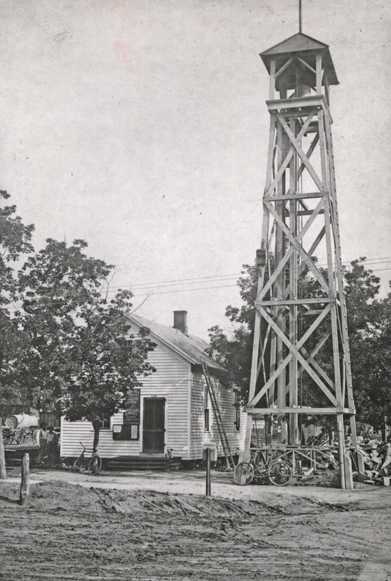
1877-1883 Greeley
Greeley was originally settled by Nathan Meeker as the Union Colony in 1869 as an experimental community. The name was later changed to Greeley in honor of Horace Greeley who was Meeker’s editor at the New York Tribune. A one-story frame building at 7th Street and 9th Avenue served as City of Greeley Town Hall and seat for courts.
|
 |
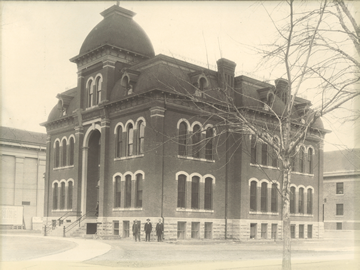
1883-1915 Greeley
The fifth home to the courts was a brick courthouse built on corner of 9th Street and 9th Avenue.
|
 |
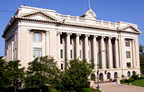
1917-present Greeley 
The present Weld County Court House stands on the corner of 9th Street and 9th Avenue.
|